Monday, February 13, 2012

Stormy nights


For my Christmas present this year Chloe bought me a shutter release for my camera, this enables me to open the shutter for as long as I want, great for star photography and also for trying to catch bolts of Lightening. A couple of evenings ago, a large storm passed in front of Sand Rivers Camp, I only have a 100mm lens so I had to pick my direction and hope for the best. After a couple of attempts I got lucky and caught this bolt.So thanks very much to Chloe.  

Lightning causes ionization  in the air through which it travels, leading to the formation of nitric oxide and ultimately, nitric acid, which benefits the plant life below.

These storms are beautiful to watch from the comfort of our lodge.


Thursday, February 2, 2012

Puddles+Baboons=water fight


At least when in rains in the Selous there are still plenty of things to keep you occupied, as this troop of Yellow Baboons show, all you need is a puddle and a sense of fun. We look forward to having you come and visit us here at Sand Rivers during the wonderful green season.

Friday, January 13, 2012

Matilda's horned viper


Yesterday, I read a BBC ARTICLE about the discovery of a new species of snake, the golden-scaled Mathilda’s Horned Viper. The researchers who described the new species have not revealed where they found it in order to protect the snake from the illegal trade in wild animals. However, the article does say that the snake’s range is probably limited to just a few square kilometers.

With a little bit of knowledge about Tanzania, we can actually deduce quite a lot of information from what’s given. Tanzania’s biodiversity hotspots, the areas with the greatest number of species and greatest likelihood of new discoveries, follow the eastern-arc mountains. The eastern-arc mountains are a series of very old ranges stretching from the Taita hills in southern Kenya to the Udzungwa mountains in southern Tanzania.

The Uluguru, Udzungwa, and Usambara mountains in particular are well known for rich biodiversity and endemic species. The mountains are so old that there has been ample time for speciation. Another factor contributing to this is the island effect of mountain tops. Each mountain top has a climate and/or soil composition that is often distinct from the base and lower slopes of the mountain. Furthermore, because mountains in Tanzania tend to have lots of water, they are good places for human settlement. As populations around the mountain increase, so does deforestation until all that’s left is a small island of old-growth forest at the very top of the mountain. As a result, each mountain top is completely cut off from neighboring mountains, even though the environmental conditions are more similar from mountain top to mountain top than from mountain top to the base of the mountain. In each little pocket of forest, completely different species evolve. Even in the Amazon rain forest, the highest rates of biodiversity occur in the hills and mountains in the western reaches of the ecosystem where you find the same isolating effect. Most telling? These island habitats tend to be just a few or a few dozen square kilometers in size.

Unfortunately, these amazing montane ecosystems are typically overshadowed by the more glamorous savanna ecosystems, so it’s nice to see them get a chance to shine. I just wish these best-kept secrets didn’t have to stay so secret.

Friday, December 23, 2011

Hunting Dogs

Carrying the head of a young Impala

It has been an exciting last few days here at Sand Rivers, large storms have been passing though during the nights and mornings, this rest bite from the heat increases the chances of seeing the predators moving during the day. One of the most exciting times you can have on a game drive is watching the Wild Dogs hunting, they are one of the most efficient predators on the planet, the young Impalas don't stand a chance against this formidable opponent. They dispatch and eat their prey with brutal efficiency, due the fear of having their kill stolen by Lions or Hyenas. High speed and organized hunts can only lead to one conclusion for their main source of food the Impala. 

Sunday, December 18, 2011

Territorial quarrels

My money is on the one on the right. 

Territorial disputes between Hippos can be settled quickly by the smaller bull showing signs of submission, or they can be settled by a full on fight if they are equal in size. In this incident which happened just in front of the lodge, the young bull who had taken a liking to the site was caught in a tight spot, behind him only rocks, so no escape possible. Forced to stand its ground, the fight continued for 20 minutes, the tusks can cause major wounds and even possibly death. At the end the larger bull gave the younger one a chance to escape, which he took, running on to the bank into the bushes.   

Monday, December 5, 2011

Catch of the day

An impressive catch!
 This young crocodile thought so too!
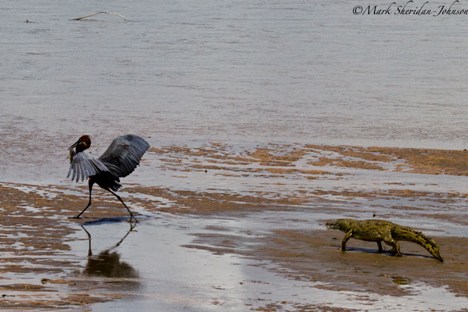
What to do? He is gaining on me!
Ahh yes I can fly!
Goliath Heron -1
Croc-0

This all unfolded just in front of the dinning room at Sand Rivers, the fish the Goliath Heron caught was larger than usual, when it hesitated in eating the large fish, this young crocodile took the opportunity to get a free meal. The Heron was in no mood in giving up his lunch and made a dash for it, only remembering it could fly right at the last minute! 


Friday, November 11, 2011

The Pinkypotamus

Anyone got any Sunscreen?
This poor fellow has got it tough, he is not a true albino as he has dark eyes and dark spots on his body, what he suffers from is called Leucism (lack of pigment producing cells)

The tropical climate of the Selous can very unforgiving, the sun belts down daily with our top temperatures reaching over 40c.

Lucky for the this Hippo he can avoid getting burnt by his special sweat that protects him from the sun. Leucism effects many different types of animals, but it probably effects predators the most, as they will never be able to sneak up on anything!